|
|
|
Loudspeakers--- What should they do? --- Design of loudspeakers --- Loudspeaker evaluation --- Accurate stereo --- Whatever happened? --- --- Room acoustics --- Sound field control --- Other designs --- System design ---
-- Other designs --
| ||||||||||||||||||||||||||||||||||||||||||||||||||||||||||||||||||||||||||||||||||||||||
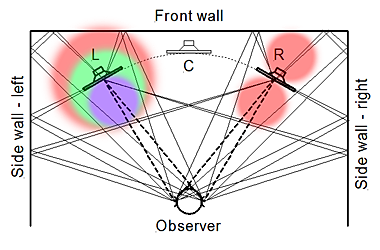 |
Loudspeakers tend to radiate uniformly into all directions at low frequencies where the radiating surfaces and cabinetry are small compared to the wavelength. They tend to beam the sound at high frequencies because the radiators are typically larger than 1/8th of a wavelength. Thus a loudspeaker, which is flat on-axis, radiates a different spectrum at angles off-axis, where the response is no longer frequency independent. Consequently reflections of the sound from different parts of the room that reach the listener will have different spectral content than the direct sound. The effect of reflections upon imaging from a stereo system has only been studied to a limited degree. It is often assumed that reflections can only have negative effects. This seems reasonable because reflections can only degrade the accuracy of a direct signal. But 2-channel stereo is about creating an illusion in the listener's mind. Neither the microphone signals, nor the ensuing ear drum signals at the listener, are accurate representations of a natural occurrence, of a natural hearing situation. The ear drum signals, though, contain cues from which the listener forms an auditory scene in his mind. If this scene is believable, then great enjoyment can be drawn from it. |
The ear drum signals also contain cues about the room, though colored in the case of a loudspeaker that radiates a different spectrum in different directions. It has been my observation that a spatially more open and 3-dimensional auditory scene is created in one's mind when the loudspeakers radiate uniformly in all directions like dipoles or omnis do. The auditory scene has great clarity and distance but not the hard edges and closeness that a highly directional loudspeaker tends to produce
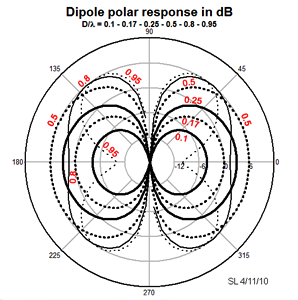 |
A dipole is the
only radiator that is directional down to the lowest frequency. I have
observed that it can produce bass output that sounds natural and
effortless and unlike what I hear from most box speakers. A dipole source
demands large volume displacements because of the phase dependent acoustic
short circuit between front and rear radiation. The effect is wavelength
dependent and reaches a minimum when the front-to-back distance D equals
1/2 wavelength, at which frequency the rear wave adds in phase to the
front wave. Above this frequency the on-axis output decreases and becomes
zero for D/l = 1. The
radiation follows a cos(a) pattern for D/l < 0.1, but widens considerably above this. In practice
this tendency is counteracted by the radiating surface becoming itself
larger compared to the radiated wavelength and thus starting to beam. This
helps when transitioning in a multi-way loudspeaker to a smaller dipole
driver for higher frequencies. But it remains difficult to build a
loudspeaker that has the same frequency response at off-axis angles as it
has on-axis and where only the overall amplitude decreases with increasing
angles. It can be done with small drivers, but then the output volume
capability is compromised severely.
Note: The graph is derived from a dipole
model consisting of opposite polarity point sources at distance D from
each other. The graph differs significantly from that, which is calculated
for "Radiation from a rigid circular piston in a finite circular open
baffle". Response widening with increasing D/l is marginal and on-axis nulls are not observed. But the
increase in 6 dB/oct on-axis slope and a dominant peak agree with observations and required equalization. |
I do not know how consistent the radiation pattern has to be. Nor do I know that constant directivity over the whole frequency range is optimum. I do know that ORION and Pluto can deliver a very believable auditory scene and that other loudspeakers with different radiation patterns often create a less convincing illusion. The problem must be how a given loudspeaker system blends with the room. Ideally the room and the loudspeakers in it are not part of the auditory scene. That scene should open effortless and untiring in front of the listener, to be enjoyed best with closed eyes.
Daniel Spadini --- LX521 from Switzerland, the French part
|
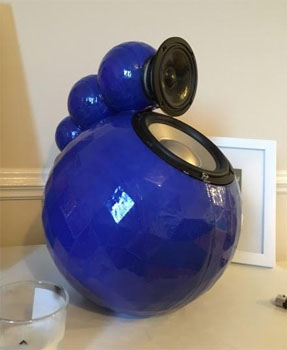
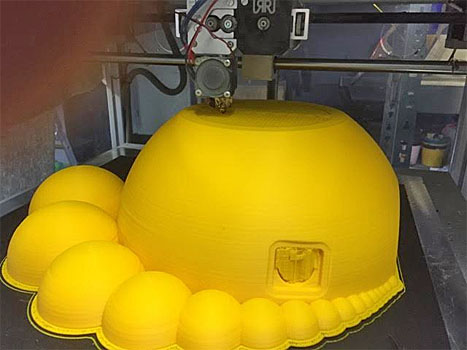
Chris Lloyd --- A 3D-printed desktop 'LXmini'
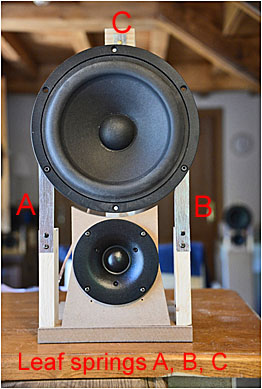
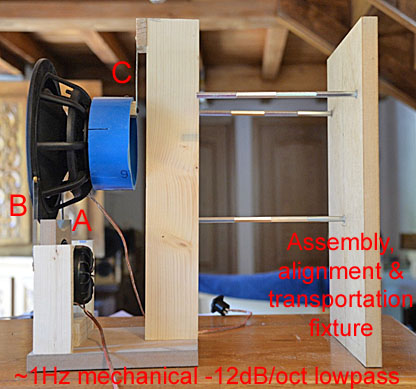
Dear Siegfried, I hope this email finds you well. I wanted to send a few picture about the experimentation with my LXmini’s. I only really listen to music in without moving around at my computer and so the as you may recall I was somewhat disappointed in my initial listening tests. I decided that i would modify the speakers for use as desktop speakers and see where it took me. I’m pleased to present my 'LXmini desktops’. I’m currently doing some comparison listening tests with the LXmini’s. The bass does not go so deep and has slightly more resonance, but to me it sounds good at high volume. There is some loss of clarity in the full range due to the design of the cabinet and lack of diffuser. The dispersion in the room is more forgiving of standing up and this was important to me. Overall they fall slightly short of the LXmini in performance, but they look good (apologies I know that this is not a consideration for you), fit on a desk next to my computer and are a good fit for my listening preferences. Anyway, I email for two reasons. Thanks again and all the best. Thank you, Chris, for inspiring me and DIYers to explore 3D-printing. The top section of the LXmini is certainly a good candidate for a new form while maintaining its acoustic function. But I have no plans to pursue this at the moment. - SL |
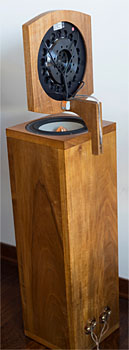
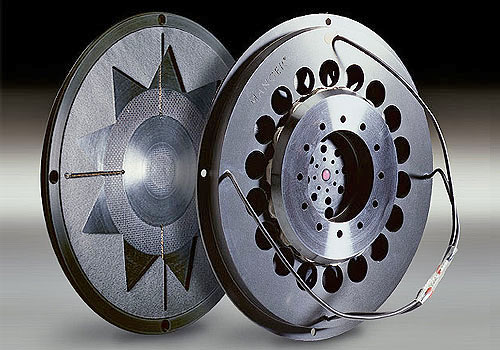
Luca Fusina --- Manger driver used as dipole
There are a number of things, but in my opinion there
are two distinctive differences between my speaker and yours: Anyway, in my speaker Thank you again for your time and have a nice Capodanno. Luca" Luca had visited me in Corte Madera and heard the LXmini. - SL |
Ruediger Franz Rauskolb --- The Ultimate DIY Sound System Is at Hand
The Ultimate DIY Sound System Is at Hand Meine Wunschliste/Systemkonzept Baffle Vibrations in Open Baffle Loudspeakers A call for an open source loudspeaker project The LXmini+2 with PowerBox 6pro NCore is my answer to a 3-way system solution. - SL |
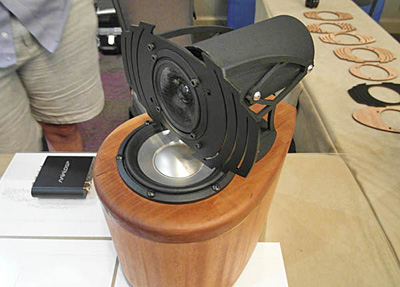
https://www.beanstalk-audio.com/https://www.stereophile.com/content/caf2016 Terms & Conditions - item 6 |
I heard these speakers at my place in
Corte Madera and was impressed by how similar their acoustic properties
were to the LXmini. The LXmini thus proved to be a robust design that
could tolerate the changes in mechanical design that the builders of the
Beanstalk JCK had made.
To me, some of the neutrality of the LXmini had been lost. The speakers had acquired a character which the designers liked. The JCKs produced a sound, and sound stage, which was truly remarkable, even though the fullrange driver was mounted to a circular baffle that increased the acoustic size of the source. I now see that the customer apparently has a choice of baffles to adapt the speakers to his/her sonic tastes. That is not a game I would like to play. A loudspeaker is a machine (transducer), which should neither add to, nor subtract from the recording, as it converts electrical input signals into air vibrations and illuminates listener and listening space with them. But if you consider a loudspeaker to be an entertainment device, then that speaker may well impart its signature on every recording it renders. And if the speaker does that particularly well for the sounds you like, then who am I to question this. Have fun! July 2016 |
Update - October 2016
|
Siegfried,
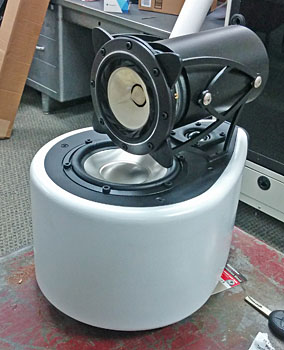
I wanted to give you a quick update and let you know the most recent developments. I'm writing this from one of our two demo rooms at RMAF. We have gone through a ground up redesign, rebranding and name change (we are now Ono Audio). I won't go into the full range of technical changes, but market forces pressed us to develop a passive version. This was, to put is mildly, a very large technical challenge. We ended up having to do a driver change up top (to the Fostex Sigma) and adding a tweeter firing upward into the diffuser, which turned out to be an extremely effective way of getting an omni radiator. This allowed us to run the Fostex full range and keep a lot of the sound character of the active system. End result is very crisp and clear and makes for a very accessible package for those not ready to jump to a fully active system. We still keep the option to run active with a dsp and we were lucky enough to be able to demo both versions at the show. We have moved to the Danville dspmusik and are hugely impressed with the clarity and sheer power of the system. The response has been overwhelming. We
just re-launched yesterday and most of the day today and yesterday was
standing room only with a line out the door at some points. Press
attention looks to be very favorable as well. A lot of people recognize
the LXmini influences and we have had some great discussions about your
work and innovations. I would say 20-30 people recognized the LXmini
design influence and at least half a dozen have built LXminis or Orions.
You have a lot of fans out there. Clearly, Ben's speaker design deviates considerably from my original LXmini. I have not heard the new speaker and will not comment on the latest changes, except to say that they continue in directions, which I would not pursue. - SL |
|
dbx SF-1A Loudspeaker |
Mark Davis: David Moran reminded me of this AES paper from 1987 in response to my comments about the BeoLab 90. loudspeaker, which controls dispersion via a multitude of drivers in a phased array. A similar approach was used for the dbx SF-1A loudspeaker, but without the benefit of DSP. At the time of publication I had already given up on
box loudspeaker design, because of the difficulties to resolve their panel
and internal cavity spurious radiation issues. Inspired by the Quad ESL63
my focus had shifted to open-baffle design with piston drivers and to the
beam forming properties of dipoles. This work led to the LX521.4 as demonstrated at the Open House, January 2017. |
**************************************************************************************************************************************
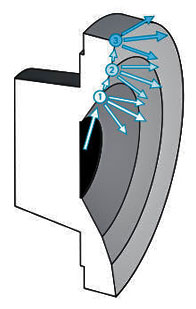 |
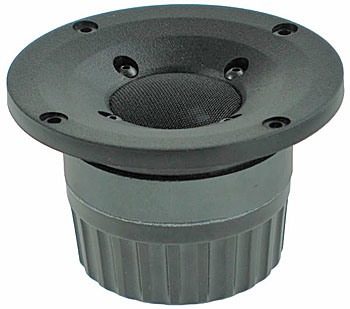
SEAS DXT
wide dispersion tweeter
DXT Technology by Michael Kragelund
This tweeter should work well in Rauskolb's Ultimate DIY Sound System above.
|
*************************************************************************************************************************************
|
Lexicon SL-1 loudspeakers and SoundSteer Technology |
|
  |
|
 |
 |
| stereophile-CES
2017 HomeTheaterHighFidelity-CES
2017 AVSForum-CES
2017
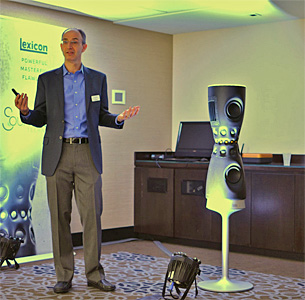
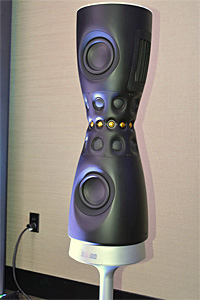
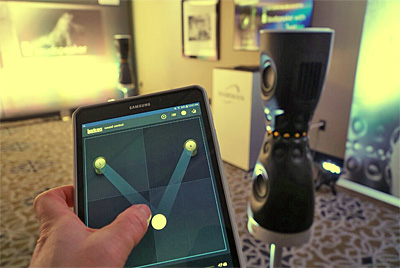
Here is a loudspeaker designed by Ulrich Horbach
from Lexicon. It appears that it has a narrowed vertical beam, which can
be varied in horizontal width and steered in the horizontal plane towards
a listener selected "sweet spot". The black section of the
speaker is about 44" tall and has a 14" diameter at top
and bottom. It uses twelve 1" tweeters, sixteen 2" midranges,
four 6" woofers with 22 channels of amplification (12x tweeter, 8x
midrange, 2x woofer) and (I guess) a 3-channel DSP driving twenty remotely
programmable delays to control beam width and horizontal direction. This loudspeaker could serve as a tool to answer
questions, which I raised in a paper presented at the AES 127th Convention
in New York, 2009: The challenge to find the optimum radiation pattern
and placement of stereo loudspeakers in a room for the creation of phantom
sources and simultaneous masking of real sources, Manuscript-2009. While the polar pattern is a steady-state response phenomenon, will the impulse response be smeared due to the delay between drivers on the circumference? |
*************************************************************************************************************************
| BeoLab 90 with DSP controlled and adjustable directivity | |
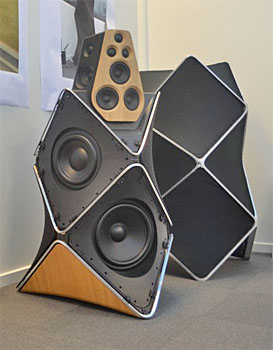 |
Here is an all-out effort
by Bang & Olufsen at a controlled directivity loudspeaker, where
directivity can be varied from a narrow horizontal beam, what I call
"headphones at a distance", to a wide beam and omni. It will be
interesting to hear whether the auditory scene is hard-bounded by the
speakers in narrow beam mode or whether the speakers and room disappear in
wide beam mode. Will it be music or music from a pair of speakers? Also,
do the acoustic cavities behind the many cones and the diffracting edges
in front of them distract from openness of the auditory scene? How varied
is the 4p power
response?
https://www.youtube.com/watch?v=yC0hjRHCYs0 https://www.tonmeister.ca/wordpress/2015/10/06/beolab-90-behind-the-scenes/ https://www.tonmeister.ca/wordpress/2015/06/30/bo-tech-what-is-beam-width-control/ https://blog.bang-olufsen.com/bo-tech-shark-fins-and-the-birth-of-beam-width-control/ https://blog.bang-olufsen.com/behind-the-scenes-at-the-launch-of-beolab-90/ |
| January 2017 - Yesterday, late
afternoon, I had the opportunity to listen to these speakers for about
half an hour using excerpts from a wide variety of my own demo material,
which I had brought with me on a thumb drive. My conclusion: Excellent
performance in aspects of neutrality of timbre, of dynamic range, of
resolution at all levels, of attack and decay, of spatial rendering in
width, depth and focus !!! The BeoLab90 tops what I have heard from any commercial loudspeaker! My slight reservations are with the bottom end. Bass is tight, explosive but lacks in spaciousness, which I hear rendered from a dipole bass like in the LX521.4. In fairness, though, I must say that the speakers were set up about 9 feet apart, against a long wall and firing across a narrow (15 feet wide?) store room in Stanford Shopping Center. So plenty of open space to the left and right of the speakers, but little room left behind a listener in the equilateral triangle sweet spot. I prefer a setup where the speaker fires along the long direction of the room. This morning I listened to some of the same tracks with my LX521.4 driven by two PowerBoxes 6pro NCore in my living room. My sweet spot's distance from the speakers and the distance between the speakers is the same as in the store. The perceived image is significantly larger in all directions on symphonic material, which has venue reverberation in the recording. Also, the phantom scene appeared more open and I felt immediately drawn into the emotional aspect of the musical performance. The bass seemed balaced in proportion to the rest of the music and in character to the size of the venue. But keep in mind that my hearing apparatus between the ears has had a long time to be trained and adapt to the LX521.4's rendering and to draw a maximum amount of information from it. At the very top of the frequency range the BeoLab90 might have more output and maybe sweetness. We agreed to explore further, to have a more leisurely and private listening session in February or March when the BeoLab90 system is fully dialed in. Yesterday the speakers were set to narrow directivity and there was no time to try other settings. So stay tuned. Before listening to the music tracks I played two
imaging test signal tracks: On track 01 the voice halfway between center and
right and the voice between center and left, was not clearly located. The
voice beyond left was properly located but not the voice beyond right.
That perception is due to an imbalance between my left and right ears.
Similarly on track 02 the highest frequency bursts are not centered
between the speakers, but turn towards the right speaker. The bursts move
to the left speaker when I face away from the speakers proving that it is
a subjective effect. |
************************************************************************************************************************
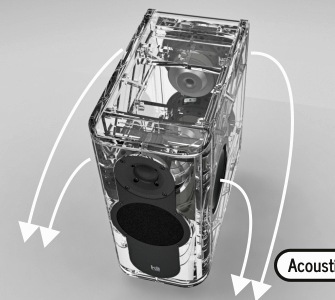
| Kii Audio THREE - Controlled Directivity: 4.8dB (80Hz - 1kHz, slowly rising thereafter) | |
 |
Bruno Putzeys of Hypex
Electronics and Grimm AUDIO
LS1 speaker fame has started a new company with a
team of talented contributors.
Here is an all-out effort at a compact, controlled directivity and low distortion loudspeaker using DSP and built-in Class-D power amplifiers. At very low frequencies the speaker starts out as omni, then turns into cardioid over more than a decade and then becomes forward directional from a wide dispersion tweeter. DSP is used to control the polar pattern in conjunction with the rear firing drivers and also to reduce driver distortion by deriving feedback control from the voice coil currents of drivers. I have not heard the speakers, but would expect the highest level of performance, i.e. a speaker that disappears from a 3D auditory scene and is completely neutral sounding in a reverberant space, whether studio or home. Hopefully the big-name manufacturers of high-end audio speakers take a lesson from this design and recognize the overriding importance of the polar response of a speaker. Designing for the on-axis response is not sufficient. |
| February 2017 - Today I had the opportunity
to listen to the Kii 3 using some of my usual test and demo tracks. The
location was a professional mixing studio room with very dry acoustics. I
would estimate RT60 to be around 200 ms. The speakers were set up on metal
stands in the middle of the large room, essentially in free-field
conditions. Listening from the equilateral triangle sweet spot the speakers immediately impressed me with their smoothness, clarity and neutrality of timbre. The phantom image was precisely detailed. It had depth and width but little height. It was somewhat like listening to an acoustic scene through a window in a wall at the speaker distance, where the speaker separation and the speaker box height defined the window size. The sweet spot was tight and lateral movement of the head quickly pulled the phantom scene to the nearer speaker. But this was in a very dry and acoustically dead room. Listening from a greater distance and also off axis, the speakers preserved their neutrality, smoothness and clarity but the phantom window boundaries disappeared, making the acoustic scene realistic in the studio. The low end was tight and articulate, and extended quite deep. But the lowest notes could not quite keep up with the higher frequency range at very high volume levels. That is not surprising, given the physical limitations of the drivers and again the dry room. The whole experience made me aware again of the importance of the reverberant field in the listening room. For sure it has to be spectrally neutral, which the Kii 3 speakers guarantee to a high degree, because of their wide polar pattern. But the room also has to be sufficiently live so that the ear-brain-perceptual apparatus can draw confirming information from the reverberant field about the spatial data in the direct loudspeaker signals to support the phantom scene illusion. A dry room is apparently a useful work environment, but I normally do not experience sounds in such environment. I prefer a room with RT60 around 450 ms. The Kii 3 is an impressive speaker, technically and sound wise, in an extremely compact and versatile package. It probably gives the most accurate conversion of electrical input to a defined acoustic field output of any speaker I know of. For my taste, it needs a lively room and then I would cross it over at 80 Hz to a pair of large dipole subwoofers. Could that be the ultimate?
|
************************************************************************************************************************
|
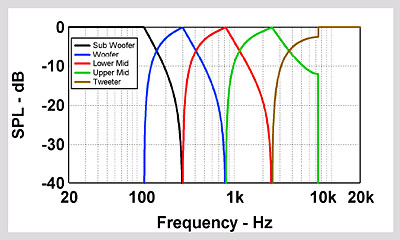
Horbach-Keele linear-phase digital crossover filters for pair-wise symmetric multi-way loudspeakers - 6/9/10 |
 |
The Audio Toolbox by Dr. Ulrich Brüggemann (((acourate))) now includes these crossover filters. |
Here is a truly ground breaking, sensible and practical
application of DSP to the design of crossover filters and the polar response
of large multi-way active loudspeakers. Very exciting work! It avoids lobing
of the
vertical polar pattern by acoustically tight spacing of the driver pairs.
Application of linear-phase
digital crossover filters to pair-wise symmetric multi-way loudspeakers |
***********************************************************************************************************************
|
Constant beam-width transducer (Keele) |
|
 |
 |
 |
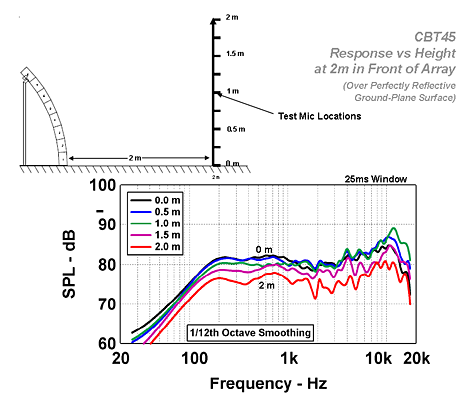 |
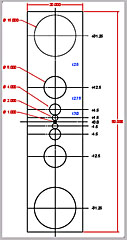
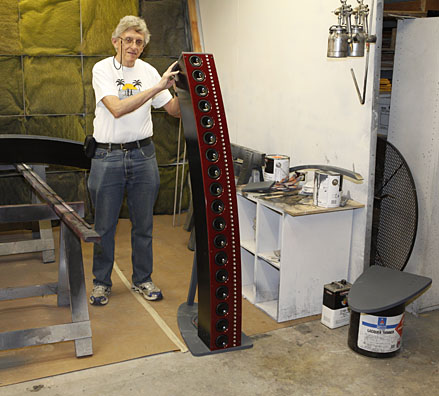
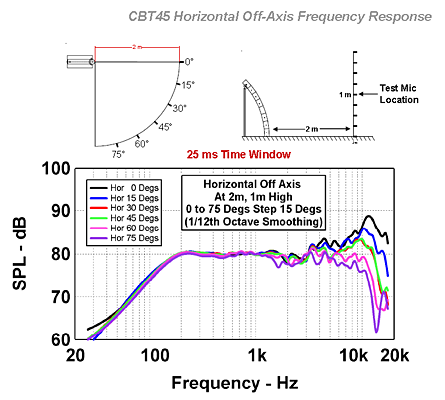
Wide and uniform horizontal dispersion and
controlled vertical dispersion up to high frequencies without lobes. The large
number of small drivers ensures high output capability, especially in the
tweeter range. The floor reflection is part of the design. The sound field is
already uniform close to the loudspeaker and suitable for near-field listening.
SPL falls off at a low rate with distance (3 dB/oct) and is nearly constant over
a distance range. This is ideal for a home theater setup with rows of seats.
(SL)
Links
************************************************************************************************************************************
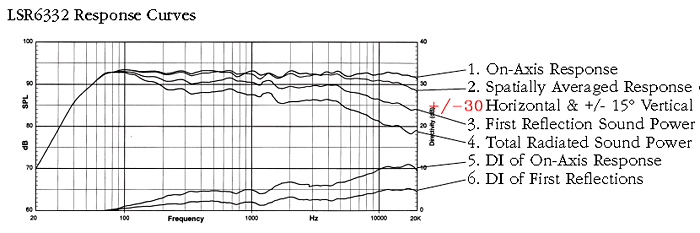
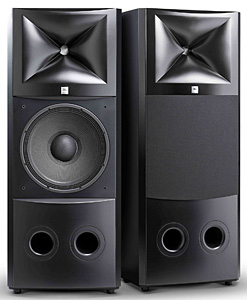
This loudspeaker exemplifies Floyd Toole's loudspeaker directivity requirements. They are the result of extensive listening tests where different box loudspeakers were ranked according to preference. The directivity index increases smoothly from 0 dB to 10 dB, without signs of the two crossovers in its frequency response. Moderately wide dispersion horizontally. (SL)
|
JBL M2 Master Reference Monitor |
||
 |
 |
 |
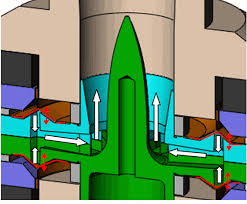
I was quite impressed with the wide dispersion, clarity and neutrality of these speakers when I heard them at an AES Convention a few years ago. Only wished they were not vented. The horn compression driver is an ingenious dual diaphragm design by Alex Voishvillo for extended high frequency coverage and low distortion at high output levels.
Alex Voishvillo, Dual Diaphragm Compression Drivers, AES Convention Paper #8502, NY 2011
*************************************************************************************************************************************
An active 3-way loudspeaker with a 10" woofer and coaxial 5" mid and 3/4" tweeter. Smooth transition from omni to +/-50 degree, -6 dB, horizontal dispersion. DSP controlled. (SL)
************************************************************************************************************************************
|
Directivity in loudspeaker systems (Geddes) |
||
 |
 |
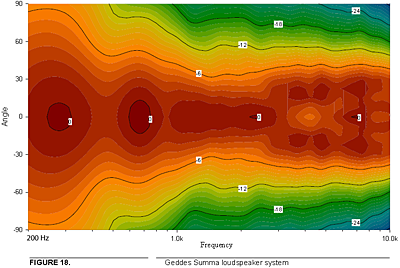 |
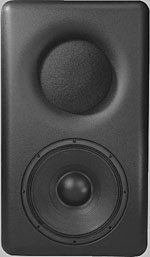
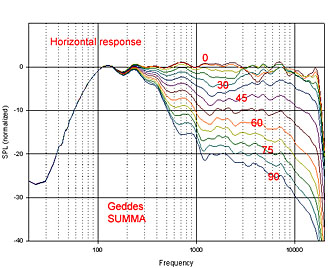
A 2-way loudspeaker with a 15" woofer and compression tweeter. Omni at low frequencies and rapid transition to a beam of +/-40 degree at -6 dB due to a 15" diameter waveguide. The narrow beam widens the sweet spot if the speakers are toed-in to cross in front of the listeners. The contour map would be even more illustrative of reality if it were drawn in polar coordinates with the frequency axis as radius and the angle covering 0 to 360 degrees. (SL)
*************************************************************************************************************************************
Danley Sound Labs (Tom Danley)
 |
 |
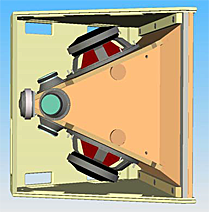
| 3-way Synergy Horn SH-50
designed in 2005, showing HF, MF and LF driver placement. "The horn can re-produce a square wave over a wide range of listener positions because the drivers are all less than l/4 apart where they interact." |
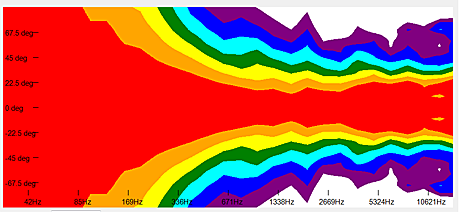
This plot is 3 dB per
color division, from 30 Hz to 16 kHz. "The horn can reproduce a square wave form, fair to excellent looking, from about 150 Hz to about 2900 Hz, a range spanning both crossovers. That is possible because the front to back positioning of drivers allows a phase shift free crossover." Horn from 50 feet and from 400 feet. |
********************************************************************************************************************************************************************************
The beneficial coupling of cardioid low frequency sources to the acoustics of small rooms (Ferekidis)
ATC Loudspeaker Technology Ltd.
The Naim Balanced Mode Radiator
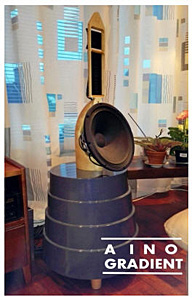 |
AINOgradient
Speakers - Juha Sirkka - 9/12/16 https://minidsp.com/forum/diy-hifi-projects/9732-ainogradient-a-4-way-active-dipole-speaker |
Cardioid
as sum of monopole and dipole speakers - Barleywater
- 2/17/15
Note the use of Kirkeby's
Inverse Filters for crossover
DIY
Loudspeakers - Kimmo Saunisto - 1/30/15
A great variety of Cardioid Bass designs
Ground
Sound - Gallery Thomas M. - 11/9/14
A cardioid loudspeaker inspired by the MEG RL901K
Here "dissipation" means "dispersion" of sound.
sondek12 (Mats
Svensson) - 3/16/13
My open baffle project on ortho acoustic design ideas
My vision for these
speakers was to build a design interacting positively with the acoustical
properties in a normal living room, creating a balanced and lifelike
reproduction of a recorded sound. I wanted to merge the design ideas of the late
Swedish speaker designer Stig Carlsson with the benefits of controlled
directivity dipolar designs. The aim has been to create a loudspeaker for
conventional placement in a normal living room, using controlled directivity and
integrated damping to suppress early reflections from influencing the direct
sound, but still to illuminate the room with later reflections for a lifelike
apparent source width and sensation of envelopment. I also wanted to use dipolar
directivity to assist time intensity trading in order to increase the sweet spot
area for believable soundstage reproduction.
Design objectives:
- Flat
on axis response for correct experience of timbre
- Minimum
of early reflections (less than 6-8 ms)
- Consistent
dispersion to assist sensation of apparent source width and envelopment in the
reproduced sound
(enhanced distribution of later reflections larger than 6-8
ms)
- Consistent
performance over complete intended dynamic range
- Designed
to work as intended with conventional placement in a normal living room
- Large
sweet spot area for a believable soundstage reproduction
keyser (Martijn Mensink) - 8/1/11
& previous design approach - 3/17/10
"- Flat frequency response, on-axis as well as off-axis by designing for a
dipolar radiation pattern from the bass range up to the highest possible
frequency.
- Operating drivers largely below the first dipole peak to maintain constant
directivity up to about 6.5 kHz. Small U-frame 12" woofers and no baffle at
all for the 6" midrange and magnetostatic dipole tweeter.
- Closed box subwoofers will be added at a later date. The stand-alone dipole is
currently equalized flat to a little below 40 Hz.
- Sufficient dynamic range. In practice it turns out that at a listening
distance of about 3 meters and an average listening level a little over 80 dB(A)
and an approximated source material crest-factor of 6 dB and broadband,
spectrally dense content, there is no audible compression or distortion. At
higher levels the sound becomes a bit congested, but I am not sure if this is
caused by the room, the speaker or even my own hearing. This is sufficiently
loud for me. I have not yet done any distortion measurements.
- Digital crossovers and equalization. Crossover frequencies are 300 Hz and 2000
Hz, both at 48 dB/oct."
DIPOL+
- 1/17/11
"Diese Seiten sollen keine Bauanleitung für Offene Schallwände
sein, sondern Hilfe zur Selbsthilfe geben. Ich versuche, die wichtigsten
Grundlagen einigermaßen verständlich zu erläutern und verweise für exaktere
Herleitungen und Hintergründe auf die einschlägigen Quellen im Netz."
(Rudolf Finke)
3/28/14 - Download Dipol_Schallwand.pdf
or Open_Baffle_Dipoles.pdf
for descriptions and results from many dipole experiments. (SL)
6.283 Audio Pages - 4/1/10
"Aristoteles and Platon are reference designs for me from which
other projects will evolve."
Monte Kay - 3/19/10
"- Envision a dipole with an acoustic black hole behind it,
completely eliminating the rear wave, leaving only the front, frequency
invariant lobe. This best describes
my directivity goal. I utilize open
baffle dipole and cardioids as tools to eliminate off axis radiation as a
partial means of achieving this. This
design objective requires significant absorption behind the speaker to
approximate the acoustic black hole.
- The “CBT” (Constant Beam width
Transducer) as described by D. B. Keele has
proven to be an effective means of achieving this goal. My home theatre center speaker combines
CBT technology with open baffle cardioids.
This focuses the rear wave at the center point of the CBT arc making it
very easy to know where to put the absorption.
Along with the proper absorption, the open baffle CBT very
effectively accomplishes my stated objective.
- Keele and
Horbach’s Linear Phase Symmetric Pair approach also accomplishes my
objective but with other limitations. The
large surface area in the sum of numerous drivers in the CBT solves other
problems not related to directivity making it a much higher performance design
over the Symmetric Pairs. As this
is a discussion of directivity objectives, the other advantages are for another
discussion."
John K - 3/14/10
"When designing a speaker system for home use
the objectives of any particular design will depend on the specifics of the
application and acceptable trade offs. As such it is difficult to state
categorically any specific set of design objectives for a CD speaker. With
regard to constant directivity, my current interpretation would be that a CD
speaker, intended for use in home environment, should have the ultimate goal of
maintaining uniform polar response above the Schroeder frequency. As a rule of
thumb, this translates to maintaining uniform polar response form about 100 Hz
and above. Specific design objectives for my designs may be found at my website."
cuibono - 3/8/10
"The primary objective is to develop an acoustically transparent
loudspeaker that is involving, enjoyable and as life-like as possible.
This means addressing primarily linear distortion issues at all angles of
radiation, and secondarily nonlinear distortion issues as they relate to maximum
output levels. This was obtained via the following goals:
1) To be a full range dipole system. In this case it is about 30Hz
to 17kHz (F-6).
2) To have as regular a dipole response as possible, defined as -1dB at 30°,
-3dB at 45°, and -6dB at 60° relative to the driver's axis. This design
goal takes special attention above 1kHz, due to the midrange driver's basket
structure, and the tweeters acoustically large size relative to the frequencies
it is producing. One compromise here is a limitation of output SPL from
the midrange. See post #35 in the Violet DSP thread for final polar
measurements.
3) To be as low cost as possible. In this case, the total driver
cost is about $400usd.
4) To be have enough output SPL to play music at live levels, while
keeping nonlinear distortion below an audible level.
(cuibono = Patrick Fleck)"
MOB3W (my open baffle 3-way) -
3/6/10
"- Constant radiation up to at least 3kHz
- Symmetrical radiation across the entire spectrum
- Sufficient dynamic range down to at least 40Hz.
- Low distortion
I have made several baffles to test what happens
with a midrange woofer on a baffle. I found that for true amplitude and phase
symmetry, I had to sink the driver in the baffle. Each midrange has at the
backside a construction directly behind the surround that has to be copied at
the front. In addition, the slimmer the baffle, the more the radiation remains
constant. This way the radiation of the AL130, the midrange in MOB3W, is made
constant and symmetrical up to 2kHz. To
obtain a radiation that is symmetrical and as much as possible constant for
the tweeter, and close to figure-8 at least up to 3kHz, I designed the
specific baffle of MOB3W. The AMT2340 tweeter 'sees' as little baffle as
possible. It has ridiculously low distortion, not at all like the ESS AMT
tweeters and the Eton ER4."
Gainphile - 3/4/10
"Affordable lifelike reproduction of music. It is possible to
build full-range dipole loudspeakers with lifelike reproduction capability at
relatively low cost. The speakers are built under $500 and well under $1000 as
complete systems including active 4-way analog crossovers and 8-channel
amplifications. There is clear benefit on the accuracy of the drive
signals by using active system. Measurable transducer distortions and
maximum SPL output are tradeoffs with such budget, yet the
loudspeakers are uncolored and loud enough to provide listeners with
enjoyable presentation."
StigErik - 3/4/10
"True dipole operation over the entire frequency range. Operate
all drivers below dipole peak to get better directivity. Decoupled drivers
and/or baffles for reduced cabinet and/or baffle vibrations. Active XO and EQ.
Choose drivers with good dynamic behavior and low distortion. Use multiple
drivers to keep cone excursions far below Xmax. XO the midrange above 300 Hz so
its less affected by the typical floor bounce suck-out. I'd like add that my listening room preferences and setup in the room differs
somewhat from what is common. I have a LEDE room which kills
most of the rear radiation from the dipoles (above 200 Hz). I also like to
listen in the near-field - my current listening distance is just 1.8 meters (it
should be rather obvious that I dont prefer to have early room reflections....)
I also like to position the speakers at 45 degree angle instead of the usual 30
degrees."
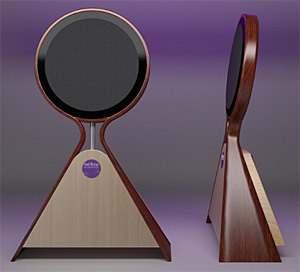 |
Mellow
Acoustics, UK - 3/2/16
Hello Siegfried, I have also been working to overcome the limitations of the ESL63 but in a different way. One of the most serious limitations is the sheer size and neither my wife nor I want room dividers! The advantage of using a smaller diaphragm is that the rings and centre disk are smaller, so there is less beaming at high frequencies, giving a more open sound. For bass, I am just using a dynamic woofer in a sealed box. I know it is not a dipole, but it still sounds well integrated with the electrostatic unit and has the advantage of small size. They aren’t the loudest speakers in the universe, but 98dB SPL at 1m (from the electrostatic unit) is good enough for me. Best, Tim |
aaninen
- 12/14/15
A Finnish manufacturer of a dipole loudspeaker. Also discussed here.
 |
Gerhard
Meier, RoomAudio
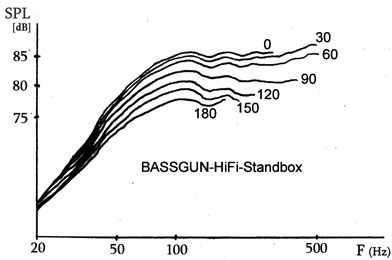
& BASSGUN, Germany - 9/25/15
Two drivers with opposite polarities are mounted in back-to-back sealed enclosures. Reduced rear radiation of the driver combination is obtained from passively lowpass filtering the rear driver. |
 |
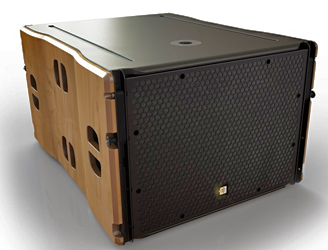 |
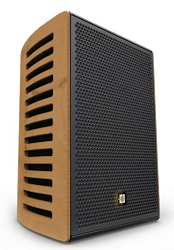
A fullrange, cardioid-like horizontal polar response from 100 Hz to 20 kHz is obtained from a slotted acoustic resistance box behind a 18" midrange driver and a forward radiating constant directivity waveguide with a 1" compression driver. The 35 Hz to 150 Hz subwoofer box uses a 18" driver in a vented enclosure and a 15" driver in a rear enclosure to cancel rear radiation. The on-axis frequency response is controlled via DSP. facebook page of Dutch & Dutch |
MURAUDIO
- 11/17/14
Omni directional electrostatic above 450 Hz, becoming acoustically large at
higher frequencies. Sealed omni woofers below 450 Hz.
amphion
- 11/8/14
Krypton 4 - Cardioid with monopole woofer
activAudio
Isostatic DIPOL-SERIES
Planot Speaker -
11/5/11
A cylindrical radiator with supposedly an omni-directional radiation pattern
horizontally. A radically new driver design.
KEF Blade
- 5/25/11
An elevated acoustic point source that smoothly transitions to a forward
radiating source with the same acoustic center at higher frequencies
DANLEY SOUND LABS - 1/7/11
Synergy Horns and Tapped Horns
Benk Cube
Overhead loudspeaker with 360 degree horizontal dispersion of sound for PA
applications
pSpeakers
Uniform-directivity loudspeakers using horns.
From some
time ago
A variety of significant speaker designs collected by Roger Russel of
McIntosh Loudspeaker fame.
TIMEDOMAIN
Theory and technology behind small, single driver omnis.
Stereolith
A single box stereo loudspeaker with identical drivers on left and right sides
and a single, mono tweeter on top. The L and R drivers on the sides are coupled
via the internal air volume, which is a spring at low frequencies and becomes a
transmission line for distances >l/8 between the drivers. This causes dipole effects with peaks and
dips at various angles. It is claimed that the brain handles such radiation
favorably.
Grimm AUDIO
A wide baffle 2-way loudspeaker with an IIR crossover, which imposes exact LR4
acoustic slopes crossing at 1550Hz. The phase is subsequently corrected using an
idealized inverted all-pass filter, resulting in a maximally linear phase
response without any pre-echo’s.
musicelectronic geithain gmbh - MEG
RL 901K studio monitor with cardioid response in the bass region. No detail is
revealed in a news interview how the two 30 Hz to 300 Hz flow-resistors have
been constructed and actively equalized.
Georg Neumann, GmbH
Directivity smoothly increasing from omni to a +/-30 degree beam, forward
horizontally
Steinway-Lyngdorf
Dipole and boundary woofer
Philips
Omni
Aether Audio
Omni and low edge diffraction tweeter with low xo frequency
Amphion Loudspeakers
Omni-cardioid-waveguide tweeter
Rountree
acoustics
Omni and forward radiating ribbon tweeter
jamo
Dipole except for tweeter
Perfect 8
Line dipole with ribbon tweeter
Gradient
Helsinki - cardioid with dipole woofer
EVIDENCE
- cardioid with monopole woofer - 11/8/14
BeoLab 5
Omni at low frequencies and horizontal dispersion lens for highs
mbl
101
Omni
GERMAN PHYSIKS
Omni
WOLCOTT AUDIO
Omni
Duevel
Omni horn
RAAL requisite
Ring radiator
morrison audio
Omni
Geddes Loudspeakers
Omni at low frequencies, transitioning to narrow and constant directivity at highs
Danley Sound Labs
Innovative Synergy Horns with high directivity for PA applications
***************************************************************************
|
| ||||