| |
Digital Photo Processes
-- Introduction
-- Lens
& image -- A/D conversion -- Lumix & Leica
-- Sharpness -- CCD noise1 -- CCD
noise2 -- 5 years later --
Comparable Lumix
and Leica camera models
|
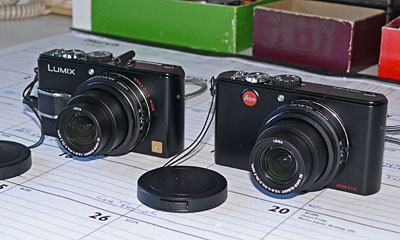
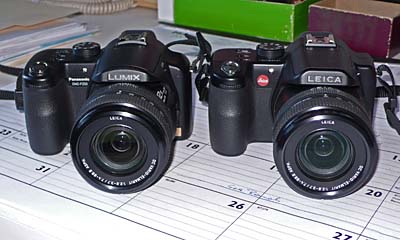
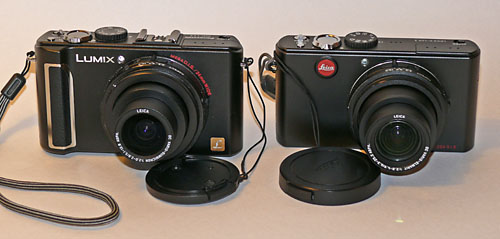
From its physical appearance and published specifications
it appears that the Panasonic Lumix DMC-LX2 is very similar to the Leica D-LUX 3
and the Lumix DMC-FZ50 is similar to the V-LUX 1. The cosmetics are slightly
different. The Leica versions have hard edges on the sides of the camera body.
In the case of the D-LUX 3 this actually gives a firmer grip on the small
body.
It is claimed on the Internet that JPG processing in the
Leica model is less aggressive, but presumably there is no difference in the RAW
output compared to the Panasonic version. Some of my tests showed a difference
in the RAW output appearance between the FZ50 and LX2. Thus I wrote an email to
Leica USA with the question:
Before purchasing the Leica D-LUX 3 camera I
need to know if the RAW files are truly raw data or if some processing has
already been applied that smoothes the output from adjacent pixel locations.
This apparently has been done in the related Panasonic DMC-LX2 as I
noticed from analyzing its raw output in Lightroom and comparing it to the Leica
V-LUX 1 output.
|
I received the following response:
The proprietary firmware in the Leica D-Lux 3
is designed around our preferences and is therefore different than that in the
Panasonic Lumix model. However we do not have any specific details
available regarding how the Raw captures are handled in any of the cameras.
There is a considerable price difference between the D-LUX
3 ($600) and the LX2 ($377) and even more so between the V-LUX 1 ($849) and the
FZ50 ($466). So what am I missing besides Leica's red dot and a one year longer
warranty when I buy the Panasonic model?
In October of 2007 I had a private tour of the Leica M8
manufacturing facility in Solms, Germany. It had been arranged by a relative who
used to work in the Leitz Wetzlar microscope development group. It was a most
impressive introduction into Leica's dedication to product quality, to the
tooling, testing and calibration which are necessary to guarantee the
consistency of a superb design in production quantities.
I also gathered some hints about the differences between Leica and Panasonic
products. The lenses were designed and specified by Leica but are being
manufactured in Japan. I saw in Solms how lens elements for the M8 were
individually ground, polished and tested. This is a slow process even when rows
of robots are used and it may take up to 40 minutes for a single, critical
element. In contrast Panasonic uses mass production techniques where multiple
lens elements are mounted to the same grinding and polishing head and they are
all worked on simultaneously. This leads to some variability between element
finishes. Furthermore, not every lens element is tested. Instead samples are
taken and measured to keep the manufacturing process under control and within
specifications. Thus one can expect some variability in the lens performance.
See the Sharpness page. I
could not find out if the Panasonic built lenses, when used in a Leica product,
would have to meet tighter specification than what is shipped in a Lumix. I only
learned that if Panasonic would ship a Leica branded product that does not meet
Leica's specifications, it would have expensive consequences for Panasonic. Thus
I assume that Panasonic keeps tight control on their lens production and will
not use a potentially costly process of selecting lenses for Leica. More likely
they will assure that every lens meets Leica specifications and tolerances.
The data processing firmware is designed around Leica
preferences. So there is a difference, but it only carries an initial
development cost. It adds value though.
The remaining critical element for picture quality is the
light sensor, the charge-coupled-device or CCD. There is usually some
variability in CCD performance due to imperfections in the semi-conductor
material and chip manufacturing process. It shows up also in its noise
performance. Thus one can assume that each CCD has been tested for acceptability
and that possibly they are sorted according to their application. I have found
from testing the four cameras that the FZ50 and V-LUX 1 sensors show very
similar noise behavior and for the FZ50 sensor actually somewhat lower noise
than for the V-LUX 1. The LX2 is noticeably noisier than the D-LUX 3 but slightly
less so than the FZ50. The D-LUX 3 exhibits the lowest noise of the four
cameras. It leads me to assume that it uses a selected CCD to meet Leica
specifications. My tests are on the CCD web pages.
So, if I am correct in my observations, what do you
get when you buy the Leica V-LUX 1?
You get a camera that meets the Leica specifications and that is guaranteed not
to exceed their tolerance limit. The FZ50 might have a higher tolerance limit on
the CCD. If so, you might get one which is noisier than the V-LUX 1. In my case
it appears that I tested a FZ50 which is noise-wise below the V-LUX 1 limit.
The D-LUX 3 appears to use a CCD with tighter
specifications and if so will provide better image quality in low light portions
of a photograph than the LX2. Both cameras use a CCD design that gives a
different noise pattern than the CCD in the V-LUX 1 or the FZ50.
These are my conclusions about the camera differences.
Since they are based on testing one sample from each model they are
statistically speaking not solid. I just wished that Leica would be more
forthcoming about what is really going on. Since the company is usually very
committed to quality I will assume that this is also reflected in their compact
digital cameras, and not just in the M-series. It would be valuable for a
potential buyer to know what is special about a D-LUX 3 or a V-LUX 1 and other
models that seem to have a lower cost "equivalent". Hopefully it is
not only a Leica brand mystique.
----------------------------------------------------------------------------------
I had written to Leica in Solms about my comparison tests
in March, 2008, and that I would appreciate their comments and corrections, hoping to add those
to my web pages. Meanwhile their CEO, Steven K. Lee, has been fired. Presumably
the company is in some turmoil. Thus it might take a while. Well, I never got a
response to that message.
--------------------------------------------------------------------------------
Waiting is over!
The Panasonic
Lumix DMC-LX3 is the camera that fits my wish list almost perfectly. It was first
shown in July, 2008 in Japan and took a while to become available in the US. I
received mine in September from J&R
at the surprising preorder price of $399. I have been happy with the
camera ever since. In particular, I like being able to use the combination of
wide F:2.0 aperture, ISO400 and image stabilization. It results in ambient light
photographs with very good image quality without flash. On the other hand the
hot shoe on top of the camera provides for using a more powerful flash with TTL
settings and bounce. Based on the results of my previous comparison tests I have
absolutely no longing for the equivalent Leica D-Lux4, but I greatly appreciate
the results of the joint effort between Leica and Panasonic.
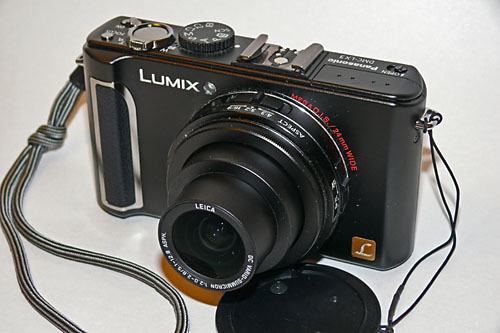 |
The LX3 is solidly built and feels
substantial. Its LCD is significantly improved over the LX2, has much
wider angles of view and even in bright sunlight remains useable. Still, I
anticipate that the slip-in optical view finder will be a relief in
extreme situations of sun and snow and fast action shots.
The optional lens adapter plus a 46 mm to 55 mm
adapter ring allow me to use the UV, ND and polarizing filters, and the
magnifying lens from my FZ50 in special situations.
The 24 mm to 60 mm zoom range is optimally suited
for 90% of my type of photography and then there is still the FZ50 for
special occasions.
dpreview.com
and DigitalCameraReview.com
have detailed reviews and there is much chat about this camera on the web.
The Canon G10, while impressive, is too bulky for me and lacks low light
performance. |
 |
The new LX3 is slightly larger and
heavier compared to the LX2 (Leica D-Lux3). This just makes the camera
more marginally pocketable and I often wear it in a Lowepro Apex 30AW on
my belt.
Outside Depth x Height x Width, and weight with
battery
LX3: 54 x 62 x 109 mm, 265 gram
LX2: 52 x 58 x 105 mm, 220 gram |
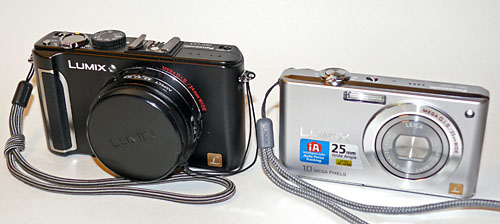 |
My wife likes to carry a camera in her purse all the time to be ready to
take photos of the grandchildren, flowers, friends or landscapes and not
be bothered by technology. She loves her slim FX37
(Leica C-Lux3) with its intelligent Auto mode and a 25mm to 125mm zoom
range and not the cameras that I handed down to her in the past. I
appreciate the image quality of this camera which is more than adequate
for its purpose.
Outside Depth x Height x Width, and weight with
battery
FX37: 25 x 54 x 95 mm, 150 gram |
In conclusion let me say that I like the
engineering of the Panasonic/Leica partnership in the optical and mechanical
departments. Their camera designs strike me as being more creative and better
trade-offs. Their user interface is more to my liking than that of the Olympus,
Nikon or Canon digital cameras that I have owned. Their weakness has been in the
sensor electronics and image processing areas. That seems to have changed with
the LX3 in particular.
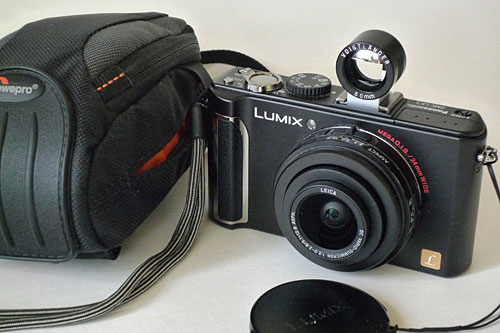 |
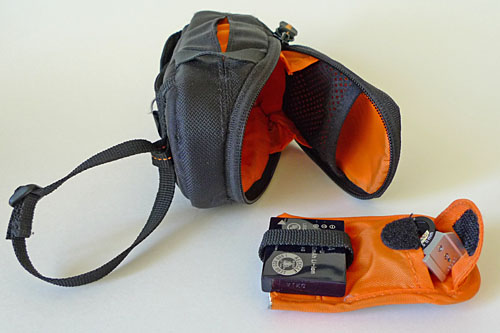
The LX3 has
accompanied me almost daily. On trips to the grandchildren, to the ocean,
the city or the country side the camera comes with me in a small pouch
that I modified to also carry a spare battery and an optical viewfinder.
The pouch goes on my belt and sometimes on a strap over my shoulder. I
attached a small loop so that the pouch is easy to pick up and carry by
hand or to hang it over the gear shift stick in the car. When taken out of
the pouch the camera often slips into a jacket pocket between taking
pictures. |
 |
The optical
viewfinder is a necessity to me, because the LCD is only marginally
useable in situations where the ambient light is very bright or when the
right moment for pushing the shutter is decisive. It is a fixed 50 mm
equivalent viewfinder with 1:1 magnification so both eyes can be open and
I merely see the picture frame added (Voigtlaender Brightline
Finder, 50 mm). I primarily use it when the LX3 is set to 60 mm focal
length or close to that and it is like working with a fixed focal length
viewfinder camera of olden days, except that I also have the benefits of
the LCD for information display and composition. The axis of the
viewfinder had to be adjusted vertically to meet the camera lens axis at
large distance. This
was done by loosening two small Philips screws in the viewfinder shoe and
adjusting a set screw until LCD and viewfinder frame matched top and
bottom. |
 |
I had first
bought a 24 mm viewfinder but did not find it useful because of the scaled
down magnification.
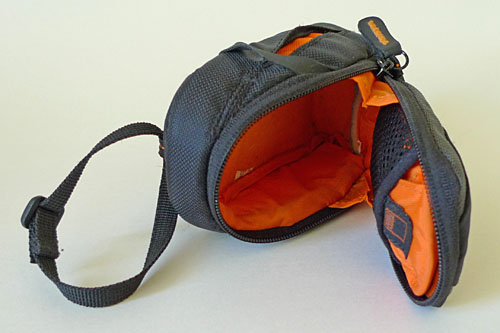
The pouch (Lowepro Apex
30 AW) comes with a tongue like internal
pocket. I cut it off at the base to make more room for the camera. Then I
shortened it a bit so that it slips into the mesh pocket, which is on the
inside of the pouch lid.
The viewfinder goes into the small top pocket which
has a Velcro closure. For the battery I added a loop so that the whole
assembly is easily put into the mesh pocket and taken out for changing
batteries. |

------------------------------------------------------------
|
As much as I love the LX3 there are occasions
where it would be more convenient to carry a small camera in my jacket
or pants pockets rather than the LX3 over my shoulder or on my belt.
Particularly so since my standard setup for the LX3 uses an optical
viewfinder and a lens adapter for protection and shade for the lens at
60 mm.
I am impressed with the picture quality of my
wife's small FX37 and thought of getting a newer version of it for
myself. But then the Sony DSC-TX7 appeared on the market. It was as
small but seemed to have better low light performance due to its Exmor R
CMOS sensor. So I bought one spontaneously. Indeed the low light
performance is impressive and the camera has some nice features like
instantaneous panorama, HDR and Hand-held twilight modes. The fast
response of the CMOS sensor makes it possible to combine multiple shots
to increase dynamic range and reduce noise by post-processing. This
takes time and so the camera feels slow shot-to-shot. While this is
tolerable in low light situations, where the TX7 indeed shines, the
heavy processing produces undesirable water color effects when there is
plenty of light. Fine texture and detail is lost. Landscape prints tend
to look painterly. Generally, pictures look impressively sharp. So the TX7 was not
quite what I had expected, though it has its place in low light or high
contrast situations. .
When I saw the Panasonic DMC-FX580 on sale for
$180 I bought one. It has the same lens as the FX37 but a newer
processor and manual controls. The feature set is almost the same as for
the LX3 except no RAW or manual focus. It handles nicely and easily slips into
my pockets. For me it has a wider range of use than the TX7 and thus the FX580
is the better alternative when not carrying the LX3. |
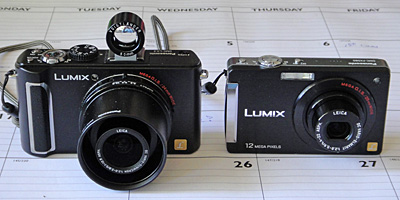
LX3 - FX580 (TX7 photo)
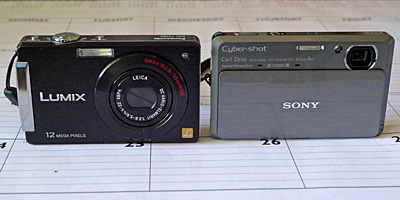
FX580 - TX7
|

FX580, 25mm, 1/640s, f/2.8, ISO125, 12.1Mp, 1/2.33"CCD, 581x581
pixels |
Comparison between FX580, LX3 and
TX7
Three pictures were cropped about 7 to 1 to show actual pixels on your monitor.
Ignore the color differences and note the rendering of detail for each
camera.
Standard camera settings were used and no post-processing was applied. |

LX3, 24mm, 1/400s, f/3.5, ISO125, 10.1Mb, 1/1.63"CCD, 537x537
pixels |

TX7, 25mm, 1/640s, f/4.5, ISO125, 10.2 Mp, 1/2.4"CMOS, 534x534
pixels |
-----------------------------------------------------------------------------------------------
-- Introduction
-- Lens
& image -- A/D conversion -- Lumix & Leica --
Sharpness -- CCD noise1 -- CCD
noise2 -- 5 years later --
|