|
|
|
Frequently asked questionsQ1 - Where can I hear the ORION? Q2 - How critical is the speaker placement? Q3 - Is there another power amplifier choice? Q4 - How is the ORION different from the PHOENIX? Q5 - Can I modify the cabinet for straight lines? Q6 - Why did you not use driver XYZ? Q7 - What should I use for a center speaker? Q8 - Are you working on a new design? Q9 - Is the crossover available with balanced inputs and outputs? Q10 - What cables and interconnects do you recommend? Q11 - Can you provide an "upgraded" crossover or "higher quality" drivers? Q12 - The ORION has noticeable baffle vibrations. Is this a problem? Q13 - What is the frequency response of the ORION? Q14 - Could I use a DSP based crossover instead of the ASP? Q15 - How does the ORION compare to speakers X and Y or Z? Q16 - Which preamplifier do you recommend for the ORION? Q17 - Are there areas for "tweaking" the ORION? Q18 - Will there be a review in one of the large audiophile magazines? Q19 - With all your claims about the superiority of dipoles why bother with PLUTO? Q20 - What contributes to the polar response of ORION+? Q21 - When do I need THOR subwoofers? Q22 - Is PLUTO more appropriate for my situation than ORION?
-------------------------------------------------------------------------------------
Q1 - Where can I hear the ORION? A1 - A number of individuals have volunteered to let you listen to the ORION that they have built. Please contact them first. If none of these volunteers lives anywhere near you, or the cost of travel for an audition becomes unreasonable, then you could try to find an ORION builder who lives closer to you and who would be willing to invite you, a stranger, into his house. But think about it like this: How many BMW owners would be interested in having you come over to test drive their new car, because you cannot decide whether to buy one or not? What is in it for them? Keep that situation in mind when you try to contact someone via the ORION Owners Forum. You could also combine a vacation in Northern California with listening to the ORION by renting the Honeymoon Cottage in Sea Ranch. And then there is the invitation that you come to my house. I live just 10 minutes north of the Golden Gate Bridge outside of San Francisco. Consider that when you purchase a commercial speaker in a store, you cannot escape paying for listening, for the dealer's time and his floor space, since that must be recovered by the retail price or the store goes out of business. With the ORION you have options and the cost of an airline ticket could be small compared to the value that you receive with the ORION. I understand your desire to hear the loudspeaker before you commit your resources to building or buying it. But even if you do not have a chance to let a listening session convince you first, I can assure you that the ORION is definitely in the very top league of loudspeakers intended for domestic use. It is for people who love music, who know what real, unamplified instruments sound like. Having heard many loudspeakers I would not know which one can surpass the Orion in its blend of overall sound accuracy, independence from the room, and integration of form and function. Ultimately though, you can only hear what is on the recording. The ORION will reveal it in all its glory, without beautification or exaggeration. Now, if your listening experience is primarily based upon listening to music through loudspeakers, rather than familiarity with un-amplified acoustic instruments and live sounds, you might not recognize accuracy immediately. In that case there might well be other speakers that you would prefer, because they have more bass, or highs, or do something else you like. Therefore listening to the ORION would be important, because there is no way for anyone to know whether the ORION matches your mental image of the ideal loudspeaker. But, if live music and acoustic sounds are your reference, then you will not go wrong by selecting the ORION, even if you cannot hear them first. Top
Q2 - How critical is the speaker placement? A2 - Basically, any dipole speaker needs breathing room
around it. Even a conventional box speaker benefits greatly from as much open
space around it as possible. When measured from the tweeter of the ORION, the
side wall should be at least 2 ft (0.6 m) away, and the wall behind the speaker
at least 4 ft (1.2 m). The side wall is not as critical as long as there is a
sufficient opening for the acoustic volume flow between front and rear sides of
the ORION. This then forms an acoustic pressure null towards the side wall. The
wall behind the speaker should be somewhat diffusive to disperse sound that is
reflected from it. In addition, the sound path from the speaker to the rear wall
and reflected back to the listener is at least twice as long as the direct path
from speaker to listener, so that the reflected sound level is far more than 6
dB below the direct sound. It is well below the reverberant
sound level in the room to which it contributes. Furthermore, the rear
reflected sound arrives at least 8 ms later than the direct sound and does not
interfere with the perception of the direct sound. The rear radiation should
not be absorbed, though. It is an essential contribution to the dipole polar pattern and power response.
The rear radiation becomes part of the reverberant sound. With a speaker separation
of 8 ft (2.4 m), and a listening distance of 8 ft, and a 4 ft (1.2 m) minimum
distance to any wall behind the listener, the minimum room size for the ORION
becomes 12 ft x 16 ft (3.6 m x 4.8 m). The ORION will not live up to its full
potential in rooms smaller than 180 ft2 (17 m2). Likewise,
placing the speaker closer to the wall behind it will sacrifice smoothness of
response, though it still provides good sound overall.
Q3 - Is there another power amplifier choice? A3 - It is important to realize that the power
requirements of a fully active and open baffle loudspeaker, like the ORION, are
quite different from those of a conventional box speaker. Woofer, midrange and
tweeter drivers each have their own power amplifier assigned to them. The
amplifier need not have any more output power than what is needed to push the
driver to its full cone excursion. Any more power than that can lead to damage
of the driver. I recommend the AT6012
amplifier with 60 W of power per driver, which is more than enough for the tweeter and midrange. This amount of power
cannot drive the woofer to full excursion at all frequencies. Towards the lower
frequencies the maximum output voltage swing limits how far the woofer cone can
be driven. At the high frequency end of the woofer range the amplifier's maximum
current swing sets the limit. This behavior is preferable since amplifier
clipping has no permanent consequences. In practice I have not even heard it.
Using a larger amplifier, like the 180 W per channel AT1806,
can give up to 5 dB more useable woofer output between 30 Hz and 60 Hz. It can
also drive the woofer seriously into its mechanical stops and damage it
permanently. Use it at your own risk. Much has been written about the sound of amplifiers in the
Hi-Fi Press. Amplifiers can sound different due to non-linear distortion
which generates new spectral components. The typical total harmonic distortion
specification is merely a guide post and not a complete measure of amplifier
distortion. THD should be below 0.1%, as a starting point, for amplifiers not to
sound different from each other. More important is the distortion at low output
power levels, below 2 W, where an amplifier spends most of its time during
music reproduction, unless it is for Hard Rock. The crossover distortion of
Class A/B amplifiers is impulsive in nature. It is very broadband and easily
overlooked in the noise floor of the amplifier output spectrum. It registers low
in a THD measurement, but the spectral components add in the time domain. They
are responsible for much of the "solid-state sound". Class A
amplifiers do not suffer from this inherent problem, but a well designed Class
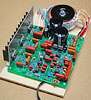
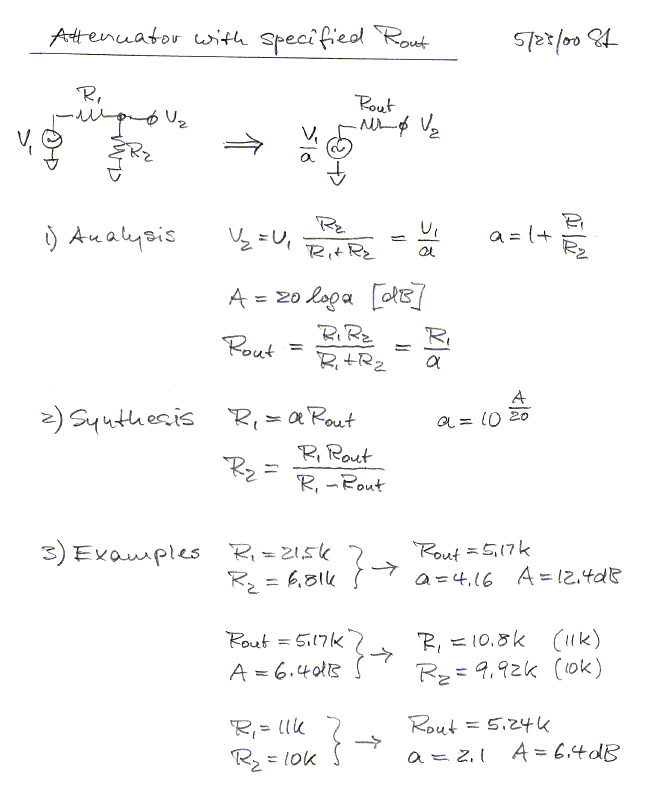
A/B can match their performance in practice. The crossover/equalizer for the ORION was designed under the assumption that all power amplifiers have the same voltage gain from input to output. It is possible to add resistive attenuators at the output of the crossover/equalizers to reduce the input voltage to the power amplifier. Thus, amplifier output voltages can be reduced to equal that of the lowest gain amplifier used. The design of the two-resistor attenuators at the crossover output is up to the ORION builder. My recommendation is to use a multi-channel power amplifier or a set of identical 2-channel amplifiers. Top
Q4 - How is the ORION different from the PHOENIX? A4 - The PHOENIX is an earlier
open baffle design. It consist of a main panel with two 8" midrange drivers
in an MTM arrangement and two 12" woofer drivers in separate cabinets for
each channel. The ORION was designed to obtain the same sound level capability
from a physically smaller and visually more appealing cabinet. This had become
possible because I had confirmed that a 24 dB/oct crossover could be used,
instead of a 12 dB/oct crossover, between woofer and midrange without any
audible effect due to increased group delay. By
shifting the crossover frequency from 100 Hz to 120 Hz and using the steeper
crossover filters I now needed only a single 8" driver to maintain the same
output capability over the midrange. The woofer drivers had to go higher in
frequency, but since they are in fixed proximity to the midrange driver there is
no placement issue and I could correct electrically for the remaining acoustic
offset. The MT arrangement gives a more uniform polar response in the vertical
direction and the tweeter sees only one midrange cone cavity that modulates its
response. In addition, new drivers had become available that measured slightly
lower in non-linear distortion and stored energy
and a 10" woofer driver with much more volume displacement than the
12" driver of the PHOENIX. The sum of this made the ORION possible. I
could not have designed it at the time of the PHOENIX. The finished ORION met my
goal of size and output when compared to the original PHOENIX. It exceeded it in
terms of driver integration, smoothness of response, clarity and overall
refinement of sound.
Q5 - Can I modify the cabinet for straight lines? A2 - The shape of the side panels was derived from
acoustic and esthetic considerations. Greater path length is needed between
front and rear of the woofers, than between front and rear of the midrange
driver to obtain the desired frequency response and voltage sensitivity for each
of their ranges. A woofer H-frame tends to have an
acoustic resonance at the high end of its frequency range. The shape of the
ORION bottom side panel for the woofer is contoured primarily to avoid that
resonance and secondarily to please my eyes. Its
curvature then transitions into the top side panel section for the midrange. In
the crossover frequency range between midrange and tweeter the on-axis and
off-axis response is determined by the proper summation of three components: the
front and rear radiation from the 8" driver and the radiation from the
tweeter. Thus, the cabinet shape and dimensions are critical, because they
affect the acoustic path length, or phase, for the summation.
Q6 - Why did you not use driver XYZ? A4 - One of the objectives for the ORION was to design it
as a 3-way system. A 2-way system would have a restricted low frequency range or
have insufficient output. A 4-way system would have added complexity and cost,
yet not improved the speaker's performance for the intended
application. Thus, I looked for tweeter, midrange and woofer drivers that
had the necessary volume displacement, polar response in an open baffle, low
stored energy, and low non-linear distortion. In addition the drivers must be
available world-wide. The Peerless 10" diameter XLS woofer, 830452,
has large excursion capability, very low air turbulence noise, relatively low
distortion, limits safely, has very low Qts due to a strong motor, and is
ruggedly built. The 8" diameter magnesium coned Seas W22EX001
Excel midrange has exceptionally low linear- and non-linear distortion over the
120 Hz to 1400 Hz frequency range used. Since the 8" driver is mounted on
an open baffle of carefully designed size it has much wider dispersion at 1400
Hz than the same driver in a closed box with the same frontal baffle. I would
have had to use two 6.5" drivers in a less favorable MTM arrangement to
obtain the same low frequency volume displacement, yet the the narrower open
baffle would have yielded little benefit in off-axis response. The 8"
midrange is matched to the Seas T25CF002
Millennium 1" soft dome tweeter, which has a smooth frequency response, low
stored energy, wide dispersion and can be crossed over at a low 1400 Hz through
24 dB/oct filters. The low crossover frequency is dictated by the distortion and
open baffle response for the midrange driver. A ribbon driver in place of the
dome tweeter would have narrower vertical dispersion, could not be crossed over
as low in frequency and would be less rugged. The Millennium tweeter uses ferro-fluid
in its voice coil gap for improved heat transfer to the pole piece. This reduces
thermal compression from continuous high sound and amplifier power output levels
which raise the voice coil temperature and thus the coil resistance. For
example, a rise in coil temperature from 20 0C to 70 0C
(68 0F to 158 0F) would reduce the tweeter output level by
about 1.5 dB. Since the midrange driver voice coil is likely to heat too, the
tonal balance would essentially remain unchanged and the insufficient increase
in output level would not be noticed.
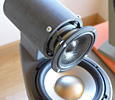
Q7 - What should I use for a center speaker? A7 - I have
no Home Theater setup. The ORION can certainly be used for a Home Theater,
especially when the THOR subwoofer is added. My
primary interest is music reproduction and the arrival of discrete multi-channel
audio in the form of SACD and DVD-A was driving me to investigate the center
channel issue. I have reported on my findings
and have no pressing need for either center or surround speakers. But, PLUTO
would be very suitable for such applications because its tonal balance matches
closely with the ORION.
Q8 - Are you working on a new design? A8 - The ORION incorporates all I learned and know at this time, but I keep scanning the horizon for any further improvements in driver design. I consider the ORION to be a platform that could grow with any such improvements. So I am not working on a new ORION. I have no interest in developing a smaller speaker since I do not see a way to get performance that would satisfy me. I also have no interest in a larger speaker since I personally have no need for it and the ORION can already cover increased volume demands by addition of the THOR. I have pursued, though, a smaller center speaker consisting of the midrange and tweeter section of the ORION. It works well, but I do not find it necessary for my listening satisfaction. My may concern is to make the ORION accessible to a wide audience, not just to DIY enthusiasts. To this end I can offer a flat pack of wood pieces for easy cabinet assembly, partially assembled cabinets or full turn-key systems through working with Wood Artistry. You can also purchase the completely assembled crossover/equalizer and minimize your time and effort of building the ORION yourself. When cost or room size are major issues, then PLUTO would be a worthy alternative to the ORION. Top
Q9 - Is the crossover available with balanced inputs and outputs? A9 - The assembled crossover/equalizer comes with gold
plated RCA Phono input and output connectors that are soldered into the ASP
circuit board. It is normally connected to preamplifier and power amplifiers via
unbalanced interconnects with RCA Phono-plugs. A balanced version is not
available. With the conversion from balanced to unbalanced
connections there is no longer protection against hum from ground loops,
regardless of cable type used. I have found in practice that hum is not a
problem at these high signal level stages, if proper precautions are taken with
equipment connection between AC power ground (Neutral) and safety ground (Earth). Details are given in
the ORION documentation.
Q10 - What cables and interconnects do you recommend? A10 - I prefer not to
recommend any specific product. Cables can have audible effects and some
manufacturers make sure they will, either through unusual electrical parameters
and/or by suggestion. Weaknesses in the design of
the output-to-input interface are exploited. In any case, sounding different does not
automatically mean that you now have a more accurate transfer from electrical to acoustical
output.
I measured the 16 gauge Megacable from Radio Shack (278-1270) that I use. A 10 foot length has 0.07 ohm resistance, 714 pF of capacitance and 1.9 uH of inductance. The line impedance is 51 ohm. A typical tweeter has a voice coil resistance of 4.7 ohm and 50 uH inductance. At 20 kHz this yields an impedance of about |4.7 + j6.3| = 7.9 ohm. Add to this the cable inductance of j0.24 ohm, and 0.07 ohm resistance for 10 feet, and the impedance becomes 8.09 ohm. This causes a 7.9/8.09 = 0.98 or 0.17 dB reduction in tweeter output at 20 kHz, which is insignificant. The cable effect is even less at lower frequencies. Speaker cables can act as antennas in the AM
frequency band and may cause distortion in the output stage of a solid-state
amplifier, if strong radio frequency signals are present. In particular, the
cable capacitance in conjunction with the inductance of a driver voice coil may
form a resonant circuit for these frequencies. The resonance can be suppressed
by placing a series R-C circuit of 10 ohm/2 W and 0.33 uF/100 V across the cable terminals
at the speaker end.
Q11 - Can you provide an "upgraded" crossover or "higher quality" drivers? A11 - The short answer is: No.
Q12 - The ORION has noticeable baffle vibrations. Is this a problem? A12 - The speaker is relatively light at 60 lb and you can feel the top baffle vibrate during high volume levels of sound. The vibration is primarily in reaction to the momentum of the moving cones (m1 v1 = m2 v2). The whole cabinet rocks back and forth, so-to-speak. Since it is all open, the resulting air movement is dipolar in nature, where front and rear radiation tend to cancel. Accelerometer measurements showed only a mild amount of energy storage around 170 Hz, which is probably due to the 8" driver basket and magnet structure and its mounting to the panel. The elastic glue joint between driver mounting panel and dress panel forms a constrained damping layer to minimize any radiation off the baffle. The side panels move only front-to-back which does not contribute to the sound. Box speakers have similar front-to-back vibrations, but in addition the cabinet surfaces flex in and out as a result of extremely high internal sound pressure level and structure borne energy transfer from the drivers. The resulting box panel vibrations are usually resonant with Q>10, leading to stored energy, which is then slowly released. Box speakers can easily radiate more sound at certain frequencies off their wall surfaces than off their driver cones. It can be a major component in the sound of a box speaker. I have tested for, but not found, any audible effects due to the vibrations of the ORION cabinet. There is nothing to be gained from making the speaker more massive. The baffles are essentially sound ducts and could be made of any material with sufficient strength to hold the drivers. Top
Q13 - What is the frequency response of the ORION? A13 - I do not show frequency response measurements,
because I have no single set of data that fully describes the speaker. The
on-axis response is flat, but that tells very little about how the speaker will
sound in your room. It has approximately a cos(a), or figure-of-eight, polar
response and that is very important for good bass response, reduced lateral
reflections, and consistent timbre in any room. I measure frequency
response at 1 inch from the drivers, at 60" from the cabinet, at 0 degrees
on the tweeter axis, at 0 degrees on the midrange axis, half way between the
two, with the cabinet outdoors on a tower 10 feet off the ground, with the
cabinet on the ground, at 30, 45, 60 and 180 degrees off-axis on the tower, the
bass response with the cabinet on the ground at the speaker opening, at 80"
from the cabinet, with the cabinet 2 feet off the ground, and many other
measurements, as necessary. I measure the raw frequency response of each drivers
on the baffle in free-space, the equalized response, the midrange and tweeter
combination, the woofer and midrange combination at different elevations and
vertical angles, the overall frequency response with different time windows and
frequency response smoothing, and so on. All this forms a large matrix of data,
that I have learned to interpret for its audible significance. I do not measure
indoors for design purposes. The measurement time window is either too short to
obtain the correct balance between low and high frequencies, or too long to know
what is the room and what is the speaker. I do not measure waterfall plots,
which contain many processing artifacts, but I measure shaped toneburst
responses for time domain information. I do not measure the "step
response", because it is an audibly meaningless test. Just study the
loudspeaker measurement data in Stereophile Magazine and note the frequent
inconsistencies in their interpretation and their correlation to what the
reviewer heard. It takes many more and different response measurements to
describe a speaker and to make predictions about its performance in different
rooms.
Q14 - Could I use a DSP based crossover instead of the ASP? A14 - It should certainly be possible to obtain the same
sonic performance from a custom designed digital crossover/equalizer as is
obtained from the analog circuitry of the ORION. One might even remove the phase
distortion of the 1400 Hz crossover, and maybe also the phase distortion of the
120 Hz crossover, but not of the 20 Hz highpass. I strongly doubt that the
removal of phase distortion will have anything
more than very subtle audible effects on the reproduction of program material,
if any at all, though I know that phase distortion can be audible under certain
conditions and for certain test signals. I have done my own tests of the
audibility of practical woofer-to-midrange and midrange-to-tweeter crossovers
with slopes of up to 24 dB/oct. Also, I have heard linear phase speakers, but
could not detect special merits or characteristics that distinguished them from
speakers with well executed allpass crossovers.
Q15 - How does the ORION compare to loudspeakers X and Y or Z? A15 - You apparently are familiar with those speakers, or consider them a reference, or have formed some opinion about them. To get an idea of where I place the ORION you might read the Design of Loudspeakers page. The Sound Reproduction page explains my design priorities and the importance I give to the motto "True to the Original". The ORION was designed to work optimally in normal living spaces without any specific acoustic treatment other than your normal "stuff of life". The Room Acoustics page goes into technical detail about that feature. Since I did not confine myself by business considerations, I had the freedom to express with the ORION the best that I had learned in over 30 years of loving pursuit. Top
Q16 - Which preamplifier do you recommend for the ORION? A16 - I have no specific product recommendation other than
that your preamplifier should have very low distortion, less than 0.01%
total harmonic distortion plus noise at 1 V output, that its frequency response
extends at least from 5 Hz to 50 kHz, and that it must have remote volume
control capability. Setting the correct volume level from the listening position
becomes mandatory for a speaker with the performance of the ORION. I consider
any modern preamplifier that does not have remote volume control as incompletely
designed and would question its justification. Of course having a remote is by
itself no guarantee of a good design either. A preamplifier should sound neither
warm nor hard and be simply transparent. I would have a preference for
solid-state gear over tubes. Though a good tube preamp would be
indistinguishable in its sound from a good solid-state preamp, the tube gear
will deteriorate over time and require maintenance. Fortunately it is easy to
design a decent preamp so your risk of hearing any signature is low, if you
choose a product within the above boundaries.
Q17 - Are there areas for "tweaking" the ORION? A17 - Yes and no. It seems that everyone has some idea of
how to "improve" a loudspeaker's sound. It is not too difficult to
change the sound subtly by exploiting weaknesses in the interface between power
amplifier and speaker or between different pieces of equipment. But such sonic
changes, if they really exist and are not just imagined, should not
automatically be taken as improvements in accuracy, but merely as the effect of
a slight frequency response adjustment. Whether the accuracy has been improved
depends on the recording and can only be determined by extended listening and
comparison to a live acoustic reference. Thus, after you have bought or built
the ORION and lived with it for a while, so that you have listened to many
different recordings, you might try to determine whether the woofer and tweeter
level settings are truly optimum for the given set of drivers with the adjustment potentiometers set to their
center position as during ASP circuit test.. The sensitivity of woofer, midrange
or tweeter driver could have up to +/- 0.5 dB manufacturing variation. The
adjustment range of the potentiometers is +/-2.5 dB with tick marks in 0.5 dB
increments. A 0.5 dB level change can be audibly quite significant even for the
woofer when listening over a longer time period and it may not manifest in the
frequency range that has been changed. The listening room sound absorption
behavior plays a role too in the overall balance of sound. This is added reason
for experimenting with the level settings. Just be careful to set neither
tweeter nor woofer level too high. One should not be aware of a speaker's bass
or highs until the program material asks for it. Too many speakers draw
attention to their "good" high and low frequency response when
uncalled for.
Q18 - Will there be a review in one of the larger audiophile magazines? A18 - I doubt that any of the popular magazines like
Stereophile, The Absolute Sound, Hi-Fi News and Record Review or their clones in
various countries would review the ORION, or even guide their readers
to this website. These magazines usually require that a new loudspeaker be
available in no fewer than 20 stores, probably as indication that the product is
for real, and also to keep their readers from complaining that the reviewed
product is not accessible to them. I have seen exceptions to this requirement,
but if they were made for the ORION, they might be of benefit to the readers but
not to the magazine. Actually it would cost the magazine money and time since I
have not invested in an inventory of speakers for temporary or long-term loan to
reviewers. Like everyone else, a reviewer either would have to build or buy the
ORION. This runs totally against industry practices where a reviewer is courted
in every way. Still, I invite any prospective reviewer to first come and visit
me to spend time listening and talking. I had a few nibbles from reviewers but
exchanges broke off quickly when it became apparent that an ORION would not just
show up at their door steps. There is much unusual design practiced in the ORION
and some of it runs against common audiophile wisdom as propagated by those
magazines. So a visit would also be important for the reviewer to decide if
he/she wants to even touch the ORION and all the background information that necessarily
would go with it,
since this might not be in the best interest of the magazine. After all, a
magazine is in business to make money. Linkwitz Lab does not even advertise in
one. On the contrary, the performance of the ORION and the information that
could be gleaned from this website might actually cast serious doubt in the minds of
readers about the true relevance of many products amongst the multitudes of
accessories, cables, interconnects, amplifiers and loudspeakers that are
advertised and promoted in the magazine's pages. Why would a reviewer want to stir up dust or point out that the
Emperor has no clothes?
Q19 - With all your claims about the superiority of dipoles why bother with PLUTO? A19 - A very large contributor to the naturalness of sound
from the ORION is the uniformity of its off-axis or power response, since this
sound is heard via room reflection and reverberation in addition to the direct
sound coming from the speaker. If this is true, then any other speaker with
uniform off-axis response should also sound natural in a room. An
omni-directional, monopole or acoustic point source is another form of
loudspeaker that can be built with uniform off-axis frequency response over a
very wide frequency range, from bass to the tweeter. I had heard such speakers
and was impressed how they disappeared and imaged precisely when set up in a
room with good acoustics. A point source requires acoustically small radiators
and having seen and tested some promising small drivers I designed and built the
PLUTO as an experiment and to prove the above claim for the ORION. I was
actually surprised how similar the two very different loudspeakers sounded,
provided that I listened to PLUTO from a closer distance to reduce the increased
contribution of the room to its sound. This small speaker should be looked at as
a "near-field monitor" in terms of its placement, but capable of a
wide dynamic range and neutral sound reproduction with superior imaging. The
direct sound of the ORION reaches deeper into the room and provides a degree of
realism that cannot be obtained with the size and much less expensive drivers
used for PLUTO. Thus it belongs
where room size or budget do not allow for the ORION, or when small center and
surround speakers are needed which match the timbre of the ORION.
Q20 - What contributes to the dipole polar response of ORION+? A perfect dipole generates sound pressure that varies as p = cos(angle) for different directions. Thus at 0 degrees p = 1 or 0 dB. At +/-45 degrees off axis the pressure is 3 dB down, at 60 degrees it has decreased to -6 dB, and at 90 degrees there is no radiation. The shape of the polar response is like two tennis balls that touch each other. A practical dipole like the Orion+ follows this pattern
quite closely in the horizontal plane, but deviates from it in the vertical
plane due to driver spacing and layout. Thus, horizontally, from the lowest bass
frequencies up to about 400 Hz you have perfect dipole behavior. The open baffle
is small compared to the radiated wavelength over this frequency range. Front
and rear radiation interact freely causing the characteristic 6 dB/octve
highpass response which is corrected in the ORION crossover/equalizer. Looking at it another way, the horizontal directivity
index of the Orion+ starts out at 4.8 dB in the bass, wiggles somewhat around
this value between 400 Hz and 4000 Hz and then smoothly increases to about 10 dB
at the highest frequencies. This is
significantly less overall directivity change than from a conventional box
loudspeaker which starts out with 0 dB directivity at low frequencies and tends
towards 13 dB at the top end, changing from omni-directional to forward beaming.
Thus the off-axis frequency response is not flat and therefore room reflections
cannot be copies of the direct sound. Also there are often significant steps in
the directivity index in the crossover region between midrange and
tweeter. The vertical polar pattern of the ORION+ is dipolar but not perfectly. In general it is narrower and particularly so in the transition region between midrange and tweeter drivers due to their physical separation. Much of the above explanation can be derived from the measured frequency response data for the open baffle Phoenix loudspeaker system, though this loudspeaker has an MTM driver arrangement and only a forward firing tweeter. ORION+ evolved from the Phoenix.
Q21 - When do I need THOR subwoofers? The subwoofers increase the output volume capability below 50 Hz. The ORION and THOR combination maintains the same frequency response as ORION by itself. I recommend to start out with ORION. Add THOR later when you find that you bottom the woofers on your preferred program material at high volume levels. But, if you know that the system will be primarily used to watch action movies, then for sure add THOR to left and right ORION. If you listen a lot to organ music, or like to impress your friends with trucks and helicopters shaking your living room, then again add THOR's. I recommend to use the AT1802 for maximum volume capability. The bridged AT6012 amplifiers will clip sooner, but you have them sitting idle while you use this amplifier for the ORION. I have THOR's in my system ready for demonstration, but I have found that I do not turn on the AT1802 for my kind of listening, though I play music at reasonably high volume levels.
Q22 - Is PLUTO more appropriate for my situation than ORION? If you have neither the money nor the room (>280
ft2 or >26 m2) to place the ORION properly away
from walls, then PLUTO will be the most balanced and accurate sounding
loudspeaker you can find.
|
|
| ||||